Salem Oregon
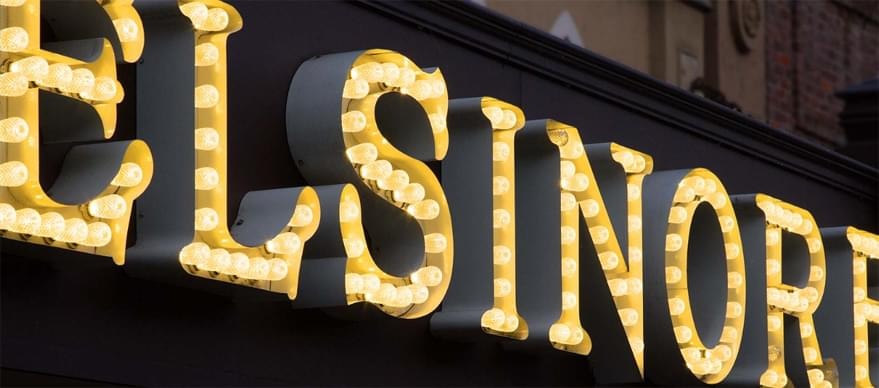
Elsinore Theatre
Having a theatrical “Full House,” thrills the in-house spirits who still find ways to help.
Spectral accident or murder victims who stay announce their presence in startling ways.
The first Owner still oversees with enthusiasm the staff and performers.
DESCRIPTION
When it opened, The Elsinore Theatre was proclaimed the “largest and most lavish theater between Portland and San Francisco.”
Oh My! What a truly glorious labor of love! George Guthrie’s 1926 castle movie and live entertainment venue, The Elsinore, was built to be one of those breathtaking atmospheric theatres, designed to be part of the entertainment offered.\
Its design and atmosphere, both inside and out, was inspired by the 16th Century Danish castle, the Elsinore Palace, in Shakespeare’s play, Hamlet. It is a wonderful blend of Tudor Palace and Gothic cathedral styles, with other elements of Late 19th and 20th Century Revival architectural styles also added.
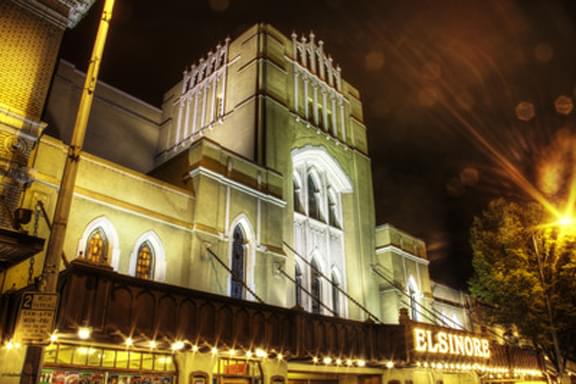 The structural bones of this wonderful building are cement, steel, with thirty foot faux stucco stone walls. The roof was made of built-up asphalt. No way was The Elsinore Theatre going to burn down or be destroyed by other climate elements! It withstood the terrible Columbus Day Storm in 1962, only losing their Marquee sign attached to the lower overhanging entrance roof.
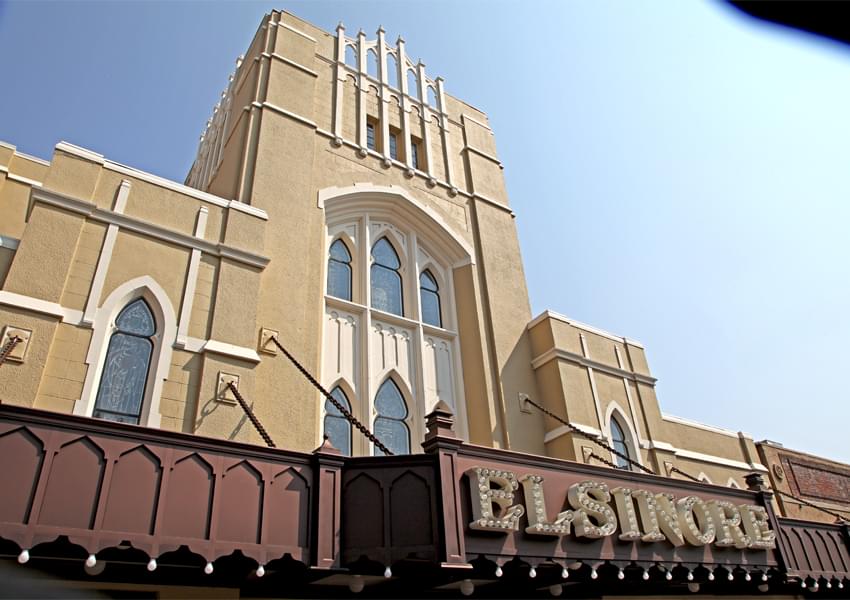
Looking at the outside front of the Elsinore Theatre, one notices designs and shapes that the average person doesn’t see every day. There is a tall rectangular middle, with two square attachments.
The tall middle section has two levels and an interesting top. On each of the two levels, there are three Tudor Gothic windows. There are interesting Tudor/Gothic decorative designs around the windows. The top of the building has what look like six swords mounted on the front, hanging down.
The Povey brothers handled all the stained glass windows. The upper balcony windows above the entrance are made of stained glass pieces from a cathedral in Germany that was bombed in World War I. These depict Hamlet, Lady Macbeth, and Portia greeting players to the Elsinore Theatre.
Each of its side square attachments also have a stained glass window. There are steel lines that attach each section to the roof of the marque, making it seem that there are three drawbridges into the place.
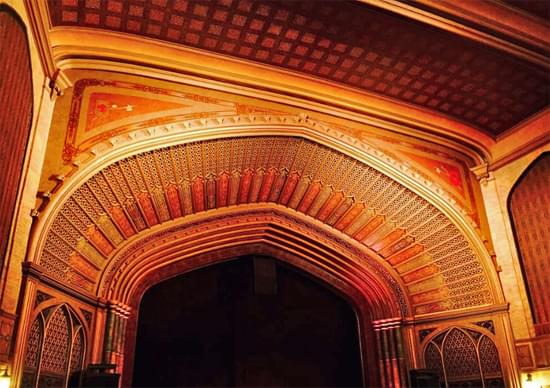
The inside of the Elsinore was designed by Fred S. Allyn in the Tudor Castle, Gothic cathedral styles, making the decor wonderfully atmospheric indeed. The auditorium was built with 1,450 seats for patrons who would enjoy the fantastic decor as well as a show or movie. The auditorium features “a 30-by-60-foot stage, framed by a decorative proscenium arch, a 40-foot fly loft, and 17 dressing rooms.”
The acoustic quality in the auditorium is so spectacular that many musicians have been “drawn to play on this stage,” throughout the years.
The inside has two lovely, carpeted grand staircases and a gloriously intricate Foyer and Lobby that takes one’s breath away.
Equally stunning are the two large, hand-painted Shakespeare-themed murals, by Nowland B. Zane, that are located over the lobby staircases. Also hand crafted are the wrought iron staircase railings, by Henry Jaegler of Salem’s Jaegler Steelworks. A new large Wurlitzer organ was installed and was the cherry on top!
HISTORY
When it opened, the Elsinore Theatre’s 1926 Reputation was as the “largest and most lavish theater between Portland and San Francisco.”
Needless to say, The Elsinore has long been an integral part of the city’s cultural scene. Performers such as Clark Gable, Jack Benny, Bonnie Raitt, Gregory Peck, Bernadette Peters, James Earl Jones, and Itzak Perlman have performed on this stage.
The story of the Elsinore Theatre began with a wealthy attorney, former Salem Theater operator and art connoisseur George Guthrie. He spent a boatload of money, 250,000 dollars, to create his artistic “atmospheric” theatre, which was quite a chunk of change in 1925-1926! Guthrie built it on land he owned that was the former home of a livery stable.
George hired the best architects and artisans that he could find. The grand exterior was the creative effort of Ellis F. Lawrence, who earned his bachelors and master degrees at The Massachusetts Institute of Technology. He became the co-founder and Dean of University of Oregon’s School of Architecture and Allied Arts.
Ellis found other talented people to help with design inside. One of Lawrence’s associates, Fred S. Allyn, designed the interior. Nowland B. Zane, a member of the University of Oregon’s Fine Arts faculty, painted the two large Shakespeare-themed murals over the lobby staircases.
 When it had its opening premiere on May 28, 1926, Elsinore Theatre opened as a silent movie cinema with a presentation of “The Volga Boatman” by Cecil De Mille, making good use of its wonderful Wurlitzer organ.
The Elsinore entertained huge audiences with silent movies and live vaudeville shows. It also hosted well known musical groups such as John Phillip Sousa. Main floor seats were upholstered in blue and gold with arms and backs of Flemish oak matching the wood used to decorate the auditorium and all three sets of entrance doors.
During the 1930s, it was a time for changes. Many children had the opportunity to sing and dance on stage with emcee Zollie Volchok as part of his Mickey Mouse Club Matinee. In 1932, new equipment was bought and installed that gave The Elsinore the ability to show “talkies.”
George sold his lease to Fox Movie Studio. When Fox moved out, George sold the lease to Warner Brothers, who ran the theatre until 1951. From 1940-1980 no money for maintenance or restoration efforts was available because audience numbers were declining. Both the popularity of TV and newer theaters in the area were hard to compete against. It wasn’t possible to make the Elsinore Theatre into a triplex.
Sometime in the 1970s, Tom Moyer bought the land that The Elsinore Theatre was built upon. As it would cost a huge amount of money to restore this grand fixer upper opportunity, this funky dame was heading for a date with the wrecking ball. Oh No! However, local preservationists stepped in to form the Save Elsinore Committee, raising $130,000 to begin restorations, which was a great encouragement to Tom, who now had a partner to help him. He relented on the tear-down plans, seeing how much the community loved the place.
The 1980s were a time of good changes and events. In 1984, all three sets of entrance doors were restored to the original Flemish oak. In 1986, Tom and the Save Elsinore Committee hosted the theater’s sixtieth anniversary celebration. Also in 1986, Clayton and Rick Parks donated and installed the largest theater pipe organ in the Pacific Northwest—a stunning 26-rank, 1,800-pipe instrument—as a tribute to the silent movie era.
In 1989, The Elsinore had been renovated and upgraded enough to actually attract buyers. Tom Moyer sold this property to Act III Cinemas. They lasted three years in business presenting films in the grand Elsinore Theatre auditorium before they offered the Elsinore to the Salem Theatre-Auditorium Group Enterprises (STAGE). They were determined to find the money to fully restore Elsinore Theatre, as well as make her a profitable enterprise once more.
The Elsinore was added to the National Register of Historic Places in 1994.
Starting with a $400,000 grant from Meyer Memorial Trust, STAGE bought and started this process first by evolving it into a modern performing arts center. This brought back an audience, and more supporters of this grand lady.
Thirteen years later in 2002, the time was right for STAGE to start an extensive $3.2 million campaign to fully restore the Elsinore to its breath-taking original 1920s glory, but with contemporary technology. They apparently had no trouble reaching their goal. Today, it is fully restored, with modern production bells and whistles. Its glorious fully restored Tudor/Gothic decor draws the public in to see ” silent films, concerts, live performances, and regional and national entertainers.”
Some spirits attached to this grand atmospheric theatre were also very happy indeed.
HISTORY OF MANIFESTATIONS
Sudden death accidents that happen in theatres can cause their unfortunate victims to continue to want to work in their old positions. They still yearn to be involved in production on stage, even in spirit.
Rialto Square Theatre, IL (Accidents happened in this theater, supposedly in the auditorium’s balcony that killed two thespians before they could perform).
Variety Theatre, OH (The spirit who was a lead member of the theatre’s past stage and lighting crew, and probably directed them in their work, had a deadly accident. However, he is not deterred from continuing in doing his job for the living).
Boulder Theatre and George’s, CO (The theatre manager, George Paper, died in an accident while trying to repair the lighting up in the catwalk. His spirit was determined to continue in the job he loved so much).
The Elsinore Theatre, OR (People who work on the catwalks of theatres sometimes fall to their deaths. This may have happened in the Elsinore Theatre).
People who die because of illness, by suicide or who are murdered in or near a theatre space often like to stick around as spirits and enjoy what they loved to do by watching others or finding ways to interact.
Saint Johns Twin Cinema and Pub, OR (A murdered Vaudevillian actor yearns to be back on stage. He tries to be a positive, supportive force).
Washington Opera House, KY (The strongest spirit who resides here was a dancer who died before a performance. She wants respect, but also tries to be helpful).
Pittsburgh Theatre, PA (Prominent actor John Johns was at the height of his profession. While preparing for a challenging role he was looking forward to performing in an upcoming play, he died suddenly from heart problems).
The Elsinore Theatre, OR (Urban legend claims that a boy was murdered inside the men’s bathroom, probably during the Mickey Mouse Matinee days).
Dedicated theatre folks in various positions and actors as well keep working and helping out despite being in spirit form. They make themselves clearly known with the living people who are running the theatre: from owners to staff to managers. Restoration of an old building can bring spectral enthusiasm to participate in the process.
Pantages Theatre, WA (People who really enjoyed their work here, have continued on in their afterlives).
The Easton State Theatre Center of the Arts, PA (A spectral theatre manager, Fred Osterstock, became its guardian through his patience and perseverance. During renovations, he again went all out to encourage. He continues to keep an eye on the living).
Mishler Theatre, OH (The spirit of Isaac Mishler says “As a spirit, I can do what I did as a living owner!”).
The Elsinore Theatre, OR (George Guthrie built the Elsinore Theatre, and as its owner kept a close eye on his staff and made sure quality was at the highest standard. He still does it with gusto. Having a theatrical “Full House,” thrills the in-house spirits who still find ways to help).
MANIFESTATIONS
The Elsinore Theatre comes with spectral crew, directors, quality control supervisors, and even a peanut gallery. Not one of these spirits is on the payroll.
Positive Spectral Team
All the spirit people love it when the theatre has a “Full House,” suggesting that they were all involved somehow in the productions of the Elsinore Theatre while alive.
There is a welcoming aura to all, especially to patrons.
Spectral Observer
A cold spot is always felt on stage.
This could be a spectral stage manager, a curious spirit child, perhaps one of Guthrie’s wives who may have been a director, or even George Himself.
The Spectral Crew
Spirit people have been seen on the scaffolding.
Disturbed dust falls down from the lighting area when no one is up there.
This is Awful!
The Spectral peanut gallery has been known to throw little stones at actors sixty feet up from the stage at actors they think are doing an awful job or if they don’t like the play.
The Spirit of the Little Girl
Has been seen playing up in the balcony and down in the auditorium where she fell.
She may go on stage to watch rehearsals.
The Spirit of George Guthrie and Two Female Spirits
He never left the building. He was seen sleeping up in the projection room soon after he died.
He still keeps a close eye on all stage productions, with two female entities by his side.
Who are the Female Spirits?
Sources disagree on the age of these female entities.
Some report that they are younger girls, while others claim that they are George’s two wives from when he was alive.
They have been seen separately in various places around the theatre.
Quality Control! Do Your Best!
George watches to see the quality of the acting and lighting during rehearsals.
He observes rehearsals on stage, and if he is satisfied, he walks away.
In the Statesman Journal digital video, a long timer said that during a rehearsal for Midsummer’s Night Dream, this happened.
“Everyone on stage saw a man standing in the front aisles watching them rehearse. Everyone thought he was alive, until he turned and walked through the seats before disappearing altogether.”
Spectral Scrutiny
People who aren’t living up to Guthrie’s standard of high quality performance or work competency get this extra spectral perk, courtesy of George Guthrie.
They feel the strong presence of someone looking at them intensely and even breathing down their shoulders.
“Did You Lock the Door?”
He keeps an eye as well on support staff.
While locking the building up, one staff member saw on the stage a shadow that should not have been there.
While there was a light bulb, called a ghost lamp, it didn’t account for this shadow.
As soon as he finished locking the last door, the shadow walked off the stage, went up the aisle, and disappeared through a wall.
Perhaps the Spirit of the Murdered Boy
Supposedly, the living can see blood in the mirror, but not much else is reported about this one.
Perhaps it is he who is up in the rafters of the auditorium throwing pebbles at the performers.
PARANORMAL FINDINGS
Actors, directors, stage hands, managers, and other theater personnel for many years have experienced these spirits making many believers in their existence here. Though The Elsinore Theatre is listed on paranormal investigation internet sites, I couldn’t find any hard evidence that has been made public.
STILL HAUNTED?
Yes Indeed! The amount of personal experiences points to theatre-loving spirits who still would like to be involved somehow and still enjoy all the shows that are presented every year. Plus, The Elsinore Theatre has been renovated and fully restored to her former glory, a big environmental factor that excites and draws back spirits who loved this place.
I’m not so sure that a boy was murdered in the men’s bathroom. Though plausible, no hard evidence such as a newspaper article describing the murder, has ever come to light nor have any photos been caught of the blood in the mirror. Plus, if this spirit was murdered and was still here, he would be active and mischievous.
LOCATION
170 High Street, SE
Salem, OR 97301
http://elsinoretheatre.com
The Elsinore Theatre can be found in the historic downtown area at the corner of State Street and High Street SE. It is only two blocks from Willamette University.
SOURCES INCLUDE
- Haunts of Western Oregon
By Kent Goodman
Schaffer Publishing – 2009 - “Tales of Elsinore Theatre’s benevolent ghosts”
By Tom Mayhall Rastrelli - Oct 22, 2014 – Ghost stories are part of the theater’s rich history and character.
elsinoretheatre.com/about-elsinore.html - elsinoretheatre.com/elsinore-support.html
- salemhistory.net/natural_history/columbus_day_storm_1962.htm
- wikipedia.org/wiki/Elsinore_Theatre
- heritagedata.prd.state.or.us
- salemhistory.net/brief_history/haunted_salem.htm
- jamesinsomnia.wixsite.com/salemparanormal/haunted-places-in-salem
- oregonencyclopedia.org/articles/elsinore_theater
- http://www.salemhistory.net/natural_history/columbus_day_storm_1962.htm
Our Haunted Paranormal Stories are Written by Julie Carr
Our Photos are copyrighted by Tom Carr
Visit the memorable… Milwaukee Haunted Hotel